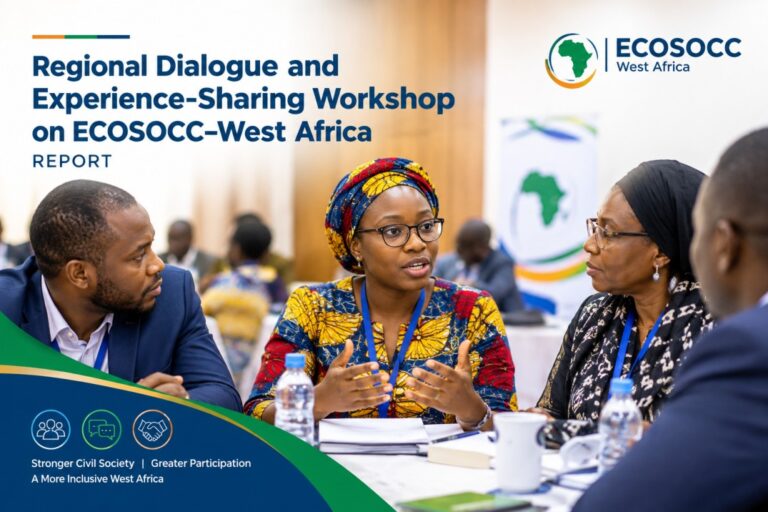

The 2026 ECOSOCC Regional Dialogue and Experience Sharing Workshop organized by West Africa Democracy Solidarity Network (WADEMOS) in Abuja-Nigeria, between 3rd and 4th August 2026, brought together total of about 35 representatives from West Africa Civil Society Institute (WACSI), West Africa Network for Peacebuilding (WANEP), ECOSOCC – AU, Campaign for Good Governance (CGG, Sierra Leone), Women Network for Development (RFLD), CDDGhana, Open Society Foundation (OSF), Yiaga Africa, Women in Politics Forum (WIPF) / WACSOF , Statview International, NGI / Kimpact Development Initiative, Governance Expert and the media, in Abuja to discuss the institutional development and future role of the Economic, Social and Cultural Council of ECOWAS (ECOSOCC-WA).
The convening focused on the theme, “ECOWAS of the People: Strengthening Citizens’ Participation and Regional Integration through ECOSOCC Engagement in West Africa,” the two-day dialogue examined how ECOSOCC-WA can provide a meaningful platform for citizens and civil society organizations to contribute to the ECOWAS integration process.
Participants reaffirmed the importance of ECOSOCC-WA in bringing citizens and civil society closer to regional decision-making, particularly on issues affecting governance, development, and regional integration. They stressed the need for an institution that is inclusive, credible, and able to operate with sufficient independence to represent diverse voices across West Africa.
A significant part of the discussion focused on the institutional design of ECOSOCC-WA, including membership, inclusion, its relationship with existing ECOWAS institutions and organs, and mechanisms to avoid duplication of roles. Participants considered how the Council can become part of the ECOWAS architecture while retaining the independence needed to engage institutions constructively and represent civil society effectively.
Funding and sustainability were also discussed, with participants exploring innovative approaches to resource mobilization that could support the Council’s programmes and operations. The dialogue also considered the structures and mechanisms required to move from the design phase to effective implementation.
The Forum further identified communication and public engagement as important to building awareness and trust in ECOSOCC-WA. Suggested approaches included targeted engagement with civil society organizations, strategic media and digital communication, and digital town hall meetings that allow citizens to learn about the Council and contribute to regional conversations. Participants also shared lessons from other continental and international systems on civil society participation and considered how these experiences could inform the development of an ECOSOCC-WA model suited to the West African context.
The discussions will contribute to efforts to develop a practical roadmap for ECOSOCC-WA, covering its institutional structure, membership, financing, implementation arrangements, and engagement with citizens and civil society.
The dialogue reaffirmed that a stronger ECOWAS requires meaningful participation from its citizens. A well-structured ECOSOCC-WA can help create a stronger connection between regional institutions and the people they serve, supporting a more inclusive and participatory approach to West African integration.